
Manufacturers face pressure to innovate faster, reduce production delays, and cut development costs. Traditional product visualization and prototyping methods feel slow and expensive today. Additionally, marketing teams struggle to explain product value early when physical samples are unavailable. Therefore, brands often lose market momentum before launch.
However, high-quality 3D product modeling services solve these recurring challenges effectively. Realistic, accurate digital models allow teams to visualize every component clearly before manufacturing. Moreover, marketing teams access product visuals early, enabling faster promotions. Engineers refine functions virtually, reducing errors and rework significantly.
As a result, manufacturers shorten cycles, minimize waste, and present products more confidently. So, 3D product modeling has evolved into a vital growth tool. Now, let’s explore how this technology at TechUrja empowers modern manufacturing and marketing teams seamlessly.
What Exactly Is High-Quality 3D Product Modeling Services?
High-quality parametric product modeling creates precise digital product representations. These models capture shapes, textures, materials, and mechanical details accurately. Therefore, teams perceive the product as if it already exists physically.
Additionally, these digital assets support animations, interactive views, and exploded assembly breakdowns.
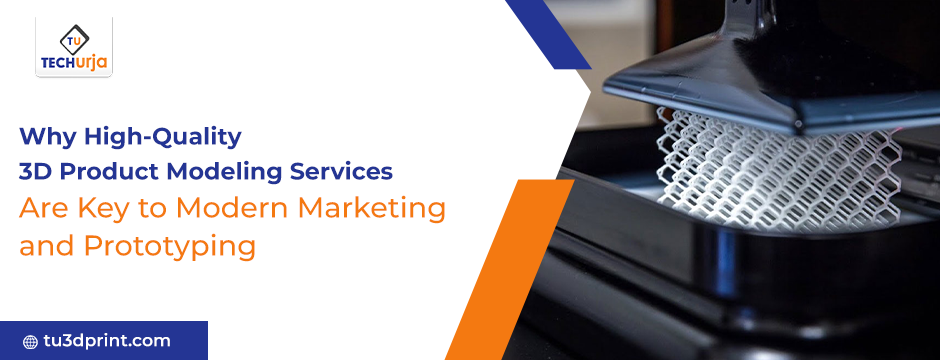
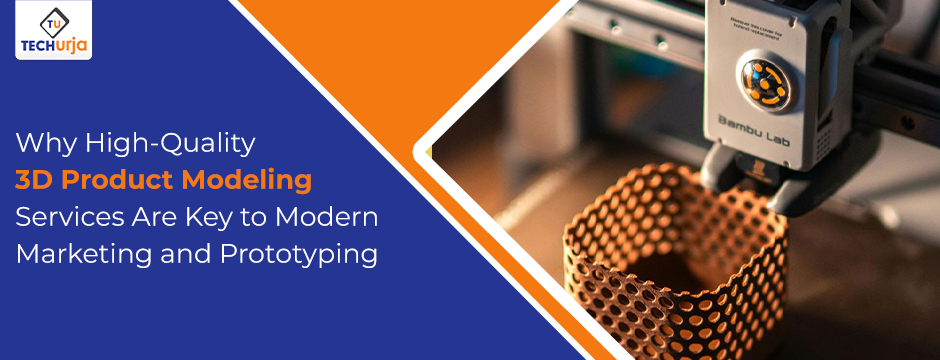
So, every component becomes understandable without physical samples. With advanced realism, manufacturers can confidently visualize design performance before production begins.3D Product Modeling Services for modern marketing and prototyping showing advanced additive manufacturing at TechUrja.
Why Manufacturers Need 3D Product Modeling Today?
Reduces Physical Prototyping Costs And Material Waste
Traditional prototyping consumes resources, time, and labor rapidly. However, 3D modeling offers virtual prototypes that help test concepts digitally. Therefore, teams avoid repeated physical builds and reduce production rework significantly.
Accelerates Product Design & Development Timelines
Product development requires speed today. E-commerce 3D models streamline brainstorming, approval, and production preparation. Consequently, concepts evolve faster, and decision cycles shorten meaningfully.
Supports Design Accuracy And Innovative Thinking
Precise models reveal scale, geometry, and technical features clearly. So, engineers identify flaws early and improve designs creatively. This leads to innovative product solutions without unnecessary trial costs.
How 3D Modeling Is Transforming Modern Marketing
Product Showcasing Without Waiting for Manufacturing
Marketing no longer waits for physical samples. Photorealistic product rendering showcases true-to-life designs instantly. So, brands launch campaigns, catalogs, and presentations much earlier and confidently.
Flexible Visual Presentation across Digital Platforms
3D models adapt to websites, ads, virtual showrooms, and social media. Moreover, brands display variations like colors, finishes, and components instantly. Hence, this boosts customer engagement and product curiosity effectively.
Consistent Visual Quality across All Brand Content
Lighting, environment, and angle remain uniform across campaigns. Therefore, brands maintain consistent messaging and premium product perception across channels.
Top Benefits of 3D Product Modeling for Manufacturers
- Realistic Virtual Prototypes: Digital twins offer lifelike previews, structural insights, and form-fit analysis. Engineers refine models confidently without material expenses.
- Instant Visual Iteration: Teams explore multiple ideas quickly using variant models and simulations. As a result, with the help of 3D product modeling services, approval cycles are streamlined greatly.
- Better Sales Communication & Pitch Materials: Complex engineering ideas become easy to understand through 3D visual storytelling. Sales teams present confidently without carrying physical samples.
- Ready for Product Experiences: 3D assets integrate into immersive visual systems easily. This prepares brands for digital selling experiences through AR/VR product visualization and smart manufacturing environments.
3D Modeling Vs Traditional Prototyping: Why It Saves Time And Budget?
Traditional prototyping involves machining, manual adjustments, and repeated fabrication. These steps consume labor, time, and raw materials rapidly.
However, 3D or virtual prototyping allows design validation digitally. Teams simulate functions, analyze tolerances, and refine shapes virtually. So, they avoid multiple revision cycles and reduce prototype rounds significantly.
Additionally, development teams collaborate remotely using shared 3D files. Therefore, efficiency increases even across distributed engineering setups. Ultimately, the process saves cost, accelerates testing, and supports faster product readiness.
How 3D Models Enable Custom Configurations And Variants?
Manufacturers serving multiple market segments require configurable product systems today. Manual variation creation demands heavy design effort and photography.
Instead, 3D model texture and lighting generate endless product variations at scale. Teams modify textures, components, and materials instantly. Therefore, businesses showcase full product families without manufacturing each option.
Moreover, customers appreciate real-time visual selection during purchase decisions. This boosts conversion and makes product exploration interactive and satisfying.
Collaboration Benefits across Engineering, Sales, And Marketing
3D models become a single source of truth for cross-functional teams. Engineers validate mechanics, marketers build campaigns, and sales create presentations. Here, well-thought-out 3D assets for animation and advertising can help. But how?
Communication barriers disappear, and departments align smoothly. Additionally, teams resolve design misunderstandings early. This improves product quality and strengthens launch success.
From boardroom discussions to vendor presentations, 3D models simplify every conversation.
Training, Support, And Post-Sales Content Using 3D Assets
Reliable and supporting manufacturers use 3D visuals to explain assembly, maintenance, and usage instructions. With animated breakdowns and interactive visuals, learning becomes intuitive and engaging.
As a result, technicians onboard faster, distributors perform better, and customers enjoy smoother adoption. Also, support costs reduce since instructions become clearer and proactive.
End Note
High-quality 3D product modeling services empower modern manufacturers across development, marketing, and sales. It accelerates decisions, enhances accuracy, reduces waste, and boosts market entry speed. Moreover, digital assets fuel promotional content, immersive product experiences, and future-ready workflows.
Therefore, adopting advanced 3D product modeling is no longer optional. It is a strategic advantage driving growth and competitive strength. Manufacturers choosing digital visualization today will scale faster and innovate smarter in tomorrow’s industrial landscape.
So, if you want to know more about 3D modelling in detail and visit TechUrja.
At TechUrja, our expertise extends beyond product modeling. We offer advanced metal additive manufacturing for durable, production-ready components, and 3D scanning for manufacturing to ensure pinpoint accuracy. Our 3D mesh repair services optimize digital models for flawless outputs, while our industrial design modeling refines every concept from prototype to perfection. Plus, our e-commerce 3D models help businesses showcase products with immersive, lifelike visuals that boost online engagement and conversions.
Get clarity before committing—our guide on selecting 3D Modeling Services helps you partner with providers that deliver consistent excellence.