
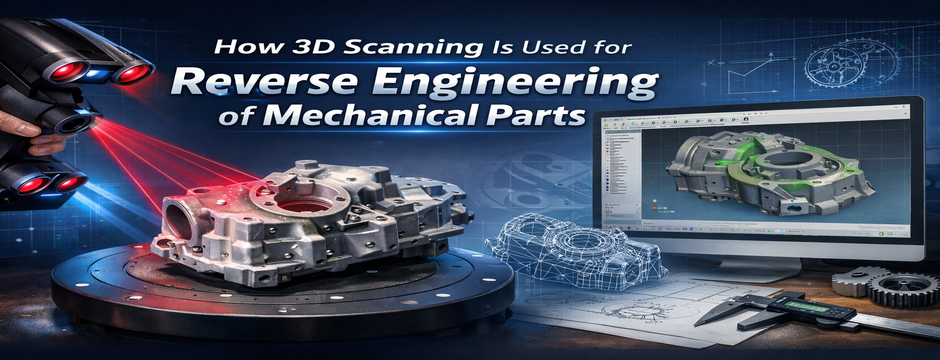
Reverse engineering has become an essential process in modern manufacturing and product development. Many industries rely on it to recreate mechanical parts when original design data is missing or outdated. One of the most effective technologies used in this process is 3D scanning. By capturing the exact geometry of a physical object and converting it into a digital model, engineers can analyze, modify, and reproduce components with high precision.
Mechanical parts often contain complex shapes, tight tolerances, and intricate surfaces that are difficult to measure using traditional tools. With 3D scanning for reverse engineering, engineers can capture these details quickly and accurately. The scanned data can then be converted into a CAD model, allowing teams to study the part, improve the design, or manufacture new components.
Industries such as automotive, aerospace, industrial machinery, and consumer product manufacturing rely on this approach to maintain production efficiency and product reliability. The combination of 3D scanning and modeling services has transformed the way engineers analyze existing components and develop new solutions.
Reverse Engineering in Manufacturing
Reverse engineering is the process of analyzing an existing object to understand its design, structure, and functionality. Engineers examine a physical component and recreate its digital design so that it can be reproduced or modified.
In manufacturing environments, reverse engineering is often required when:
- Original CAD files are unavailable
- A component is discontinued by the manufacturer
- Design improvements are needed
- A damaged or worn part must be reproduced
- Competitive products need technical analysis
Traditional reverse engineering methods relied on manual measurement tools such as calipers, coordinate measuring machines, and gauges. While these tools can measure simple features, they struggle to capture complex shapes and organic surfaces.
This limitation has led many companies to adopt industrial 3D scanning services as a faster and more accurate solution.
What Is 3D Scanning?
3D scanning is a digital measurement process that captures the shape and surface details of a physical object. Specialized scanners collect thousands or millions of data points from the object’s surface and convert them into a digital representation.
This digital representation is usually created in the form of a point cloud or a mesh model. The model can then be processed using engineering software and converted into a full CAD design.
Because 3D scanning captures the complete geometry of an object, it allows engineers to study every feature of a mechanical component without disassembling it or altering the original part.
Why 3D Scanning Is Important for Reverse Engineering
Mechanical parts often contain curved surfaces, internal features, and fine details that are difficult to measure manually. 3D scanning for reverse engineering solves this challenge by providing a complete digital record of the object.
The advantages include:
High Accuracy
Modern scanning equipment captures extremely detailed geometry. Even small design elements can be recorded with high precision.
Faster Data Collection
Scanning reduces the time required for measurement. A complex component can be digitized in minutes rather than hours.
Complete Geometry Capture
Unlike manual measurement tools that record specific dimensions, scanning captures the entire surface of the object.
Reduced Human Error
Automated scanning reduces the risk of measurement mistakes that may occur during manual inspection.
Compatibility with CAD Software
Scanned data can be converted into engineering models that can be edited, analyzed, and manufactured.
These benefits make 3D scanning and modeling services an important part of modern engineering workflows.
The Reverse Engineering Process Using 3D Scanning
The reverse engineering process typically follows a structured workflow. Each step ensures that the final CAD model accurately represents the original mechanical part.
1. Object Preparation
Before scanning begins, the mechanical part is prepared for data capture. The surface may be cleaned to remove dirt or oil that could interfere with scanning accuracy. In some cases, reference markers are placed on the object to improve tracking during the scan.
This preparation ensures the scanner captures reliable geometry from every visible surface.
2. 3D Scanning
The scanner captures the shape and dimensions of the mechanical part. Depending on the equipment used, the scanner may rely on laser technology or structured light.
The scanning device records a dense set of measurement points across the entire object surface. These points form a digital dataset known as a point cloud.
For complex parts, multiple scans are often taken from different angles to ensure complete coverage.
3. Data Processing
Once scanning is complete, the raw point cloud data must be processed. Specialized software aligns multiple scans and removes noise or irregularities.
The cleaned data is then converted into a polygon mesh, which represents the surface geometry of the mechanical component.
This mesh model forms the foundation for further engineering work.
4. CAD Model Creation
The mesh model is converted into a parametric CAD model using engineering software. This step is known as scan to CAD conversion.
Engineers analyze the scanned geometry and recreate the part using design features such as surfaces, curves, and solid structures.
The resulting CAD model can be edited, analyzed, and used for manufacturing.
5. Inspection and Validation
After the CAD model is created, it is compared with the original scan data. This verification process ensures that the recreated design matches the physical part within the required tolerance limits.
Any deviations can be corrected before the final design is released.
Applications of 3D Scanning in Reverse Engineering
The use of 3D scanning for reverse engineering extends across many manufacturing industries. It helps organizations maintain equipment, improve product performance, and reduce downtime.
Reproducing Obsolete Components
Many machines rely on components that are no longer available from the original manufacturer. Reverse engineering allows engineers to recreate these parts and restore equipment functionality.
By using industrial 3D scanning services, companies can digitize the original component and reproduce it accurately.
Product Design Improvement
Reverse engineering allows engineers to analyze existing designs and identify opportunities for improvement.
Once the digital model is created, modifications can be applied to enhance performance, durability, or efficiency.
Competitive Product Analysis
Manufacturers often study competitor products to understand design strategies and production methods.
By scanning and analyzing components, engineers can evaluate material usage, structural design, and assembly methods.
Maintenance and Repair
In heavy machinery and industrial equipment, components may wear out over time. Reverse engineering allows companies to reproduce damaged parts without waiting for supplier replacements.
This process reduces downtime and helps maintain production schedules.
Quality Control and Inspection
Scanning technology also allows engineers to compare manufactured components with their original design.
Deviation analysis can identify defects or dimensional differences that may affect performance.
Role of 3D Scanning and Modeling Services in Manufacturing
Modern manufacturing increasingly relies on digital engineering tools. 3D scanning and modeling services allow companies to move from physical objects to digital designs quickly.
These services help manufacturers:
- Digitize mechanical components
- Create CAD models for production
- Improve existing designs
- Conduct dimensional analysis
- Integrate scanned data with 3D printing or CNC machining
By combining scanning with advanced design software, manufacturers gain greater control over product development and production processes.
Advantages of Using Industrial 3D Scanning Services
Companies that use industrial 3D scanning services gain several advantages compared with traditional measurement methods.
Faster Engineering Workflow
Digital scanning speeds up the reverse engineering process and reduces project timelines.
Accurate Data Capture
Scanning equipment captures detailed surface information that manual methods may miss.
Support for Complex Geometries
Mechanical parts often contain intricate shapes that are difficult to measure manually.
Reduced Production Delays
When replacement parts are needed, scanning allows engineers to recreate designs quickly.
Integration with Modern Manufacturing
The digital models created from scans can be used with CNC machining, simulation software, and additive manufacturing.
These advantages make scanning an essential part of reverse engineering services for manufacturing.
TechUrja and Advanced Reverse Engineering Solutions
At TechUrja, we provide advanced 3D scanning and modeling services designed to support modern manufacturing and engineering projects. Our team uses high precision scanning technology to capture detailed geometry from mechanical parts of all sizes and complexities.
We help businesses convert physical components into accurate digital models that can be used for redesign, inspection, or production. Our 3D scanning for reverse engineering solutions allow companies to reproduce legacy parts, analyze existing designs, and improve product performance.
With our expertise in industrial 3D scanning services, we support manufacturers, engineers, and product developers who require reliable data and precise CAD models. Our goal is to ensure that every project moves smoothly from physical part to digital design and final manufacturing.
Conclusion
Reverse engineering plays a critical role in modern engineering and manufacturing. When design data is missing or outdated, companies must rely on reliable methods to recreate mechanical components.
3D scanning has become one of the most effective tools for this process. By capturing the complete geometry of physical objects, it allows engineers to produce accurate digital models and develop improved designs.
From reproducing discontinued parts to improving product performance, 3D scanning for reverse engineering provides a practical and efficient solution. The integration of industrial 3D scanning services with advanced CAD software has transformed the way manufacturers analyze and reproduce mechanical parts.
As manufacturing technologies continue to evolve, the demand for precise reverse engineering services for manufacturing will continue to grow. Companies that adopt 3D scanning and modeling services will gain a significant advantage in maintaining product quality, improving designs, and reducing production delays.
Frequently Asked Questions
- What is 3D scanning in reverse engineering?
3D scanning in reverse engineering is the process of capturing the exact shape and dimensions of a physical object and converting it into a digital model. This digital data can then be used to recreate, analyze, or modify mechanical parts when original design files are unavailable.
- How accurate is 3D scanning for reverse engineering mechanical parts?
Modern 3D scanning technology can capture highly detailed surface geometry with very high accuracy. This level of precision allows engineers to create reliable CAD models that closely match the original mechanical component.
- What types of parts can be reverse engineered using 3D scanning?
3D scanning can be used for many types of components including gears, brackets, housings, machine parts, automotive components, and industrial equipment parts. It is especially useful for complex shapes that are difficult to measure manually.
- How does 3D scanning help in manufacturing?
3D scanning helps manufacturers recreate discontinued parts, improve product designs, perform dimensional inspection, and create accurate CAD models for production. It supports faster development and reduces downtime in manufacturing operations.
- What file formats are delivered after 3D scanning and modeling?
After scanning and processing, the final models can be delivered in commonly used engineering formats such as STEP, IGES, STL, or other CAD-compatible formats. These files can be used for design modification, analysis, or manufacturing.