
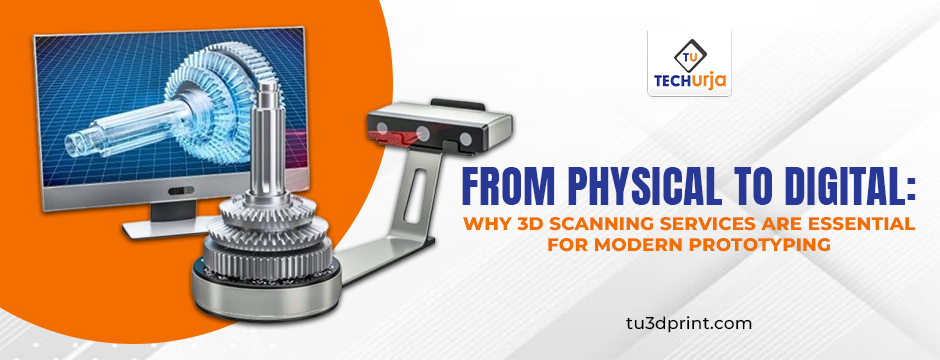
In this fast-paced world, precision, efficiency, and adaptability are important in product design and engineering. Traditional prototyping methods relied heavily on manual measurements and physical adjustments. Normally, it was slow, costly, and prone to errors, but industries are now turning to digital transformation, and 3D scanning services are acting as a bridge between physical and digital innovation.
3D Scanning is a process that captures an object’s exact geometry with very high accuracy, thus turning real mechanical components into digital 3D models that can easily be modified, analyzed, or reproduced with precision. Be it reverse engineering, product inspection, or rapid prototyping, all these services help to speed up the development cycles and reduce design risks.
From the car and aerospace industries to healthcare and manufacturing, 3D scanning today is a cornerstone of modern prototyping. It accelerates the design-to-production pipeline, facilitates collaboration, enhances quality control, and drives innovation. This paper looks into how scanning services are revolutionizing modern prototyping by covering the technology, applications, and benefits that make them indispensable to forward-thinking businesses.
The Evolution of 3D Scanning in Prototyping
Prototyping has always played an integral role in product development. Previously, it was solely dependent on physical molds and manual measuring tools used by engineers two or three decades back, which had several pitfalls of inaccuracies. The introduction of 3D scanning service technologies marked a turning point, as this enables seamless conversion of physical models into digital assets.
3D scanning is the process of capturing millions of data points from the surface of an object, enabling the rapid digital capture of shapes, textures, and details that are difficult to measure by hand. The resulting digital model can be imported into CAD software for analysis, design refinements, and virtual testing.
Cutting-edge scanning services make use of advanced sensors and optics to achieve incredible precision; in fact, the margin of error has been reduced to mere microns. Consequently, it enables designers to move from concept to prototype in record time and accelerates innovation at unrivaled accuracy.
The Technology Behind Modern 3D Scanning
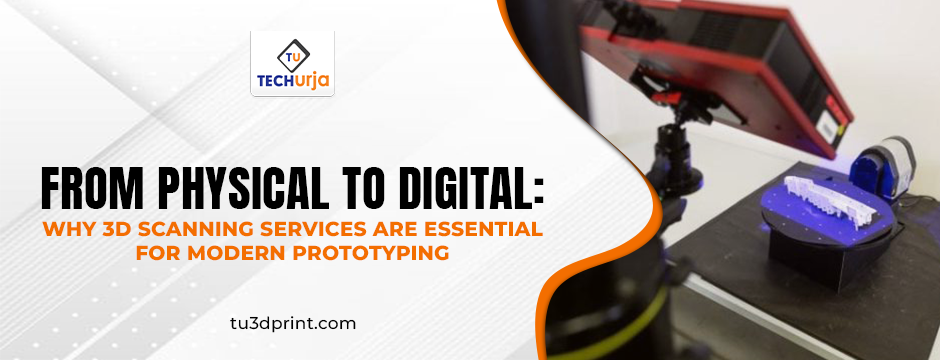
At the core of 3D scanning lies the principle of capturing surface geometry using light, lasers, or structured patterns. Today, two main technologies dominate the field: structured light and laser-based scanning.
Structured light scanning uses a projected pattern of light onto the object. As the pattern deforms across the surface, sensors record the changes and reconstruct the shape in 3D. This method is ideal for capturing complex geometries with high surface detail, making it perfect for small to medium-sized objects and artistic applications.
Laser-based scanning, on the other hand, uses a focused laser beam that sweeps across an object’s surface. The reflected light is then measured to calculate distance and geometry. Laser scanning has become a critical tool in manufacturing, allowing engineers to verify dimensional accuracy and identify defects early in the production process.
Together, these technologies form the foundation of 3D scanning, delivering digital accuracy that transforms the way prototypes are created, analyzed, and optimized.
3D Scanning and Reverse Engineering: Rebuilding with Precision
One of the most powerful applications of modern scanning technology is reverse engineering with 3D scanning. This process allows engineers to recreate the digital design of a physical part, even when original CAD files are missing or outdated.
For example, an old mechanical component that needs replacement can be scanned to generate a precise digital replica. The digital model can then be refined or improved, ensuring that the new version fits perfectly into existing systems.
Reverse engineering is particularly valuable in industries like aerospace and automotive, where legacy components often require modification or reproduction without compromising functionality. With the help of scanning services, companies can extend product lifecycles, reduce redesign time, and minimize costly production errors.
From Scan to CAD: Turning Raw Data into Usable Models
Once an object has been digitized, the next step involves converting point cloud data into editable 3D models. This process, known as CAD modeling from 3D scans, transforms raw scan data into accurate geometric surfaces that engineers can manipulate within CAD software.
The digital model can be used for design adjustments, stress testing, or performance simulations, enabling a seamless transition from physical prototype to digital twin. Engineers can refine designs, compare iterations, and prepare parts for 3D printing or CNC machining, all within a digital environment.
By integrating scanning services into the CAD workflow, teams eliminate manual design guesswork, reduce lead times, and achieve a consistent level of accuracy across all design stages.
The 3D Scan to Print Process: Bridging Design and Production
The rise of additive manufacturing has made the 3D scan a reality for countless industries. Once an object is scanned and converted into a 3D model, it can be immediately prepared for 3D printing.
This process is especially valuable for rapid prototyping, custom parts fabrication, and small-batch production. By scanning an existing part and printing its replica, businesses can bypass lengthy manufacturing cycles and instantly test design iterations.
Moreover, the integration of 3D scanning services with 3D printing technologies ensures a perfect match between physical and digital models, achieving design continuity from concept to final product.
Digital Twins and the Power of Data
As industries embrace Industry 4.0, the concept of digital twin creation has gained immense importance. A digital twin is an exact digital replica of a physical asset, used for monitoring, analysis, and predictive maintenance.
By using high-precision scanning services, engineers can create digital twins of products, machinery, or even entire facilities. These twins provide valuable insights into wear, deformation, or operational inefficiencies, allowing companies to make data-driven decisions before real-world issues arise.
Digital twins are now vital in sectors like energy, aerospace, and construction, where real-time monitoring and virtual simulations drive operational excellence.
Precision 3D Measurement for Quality Assurance
In manufacturing, quality is non-negotiable. That is where measurement for precision in 3D comes in. With 3D scanning, manufacturers can do high-resolution inspections of actual parts to compare them against their digital designs.
This level of accuracy helps find dimensional deviations in production at an early stage and ensures that each and every component has the exact specifications. Be it turbine blades, automotive parts, or consumer goods, 3D scanning offers repeatable, reliable quality checks, non-destructively, without requiring destructive testing.
3D scanning for manufacturing ensures that companies maintain strict quality control standards, while efficiency and waste are improved.
The Competitive Edge of Using 3D Scanning in Prototyping
Businesses that leverage 3D scanning services gain a significant advantage over those relying solely on traditional prototyping methods. These services enable faster turnaround times, lower costs, and more accurate results.
Design teams can collaborate digitally, sharing scan data across platforms and departments. Engineers can test fit, function, and form virtually, minimizing physical revisions and material costs.
Moreover, 3D scanning inspires creativity. Designers can now experiment with geometries that were previously unfeasible to measure or reproduce by hand. The accuracy of 3D scanning ensures creativity is never stifled due to technical limitations.
As this digitization of the world proceeds, embracing such technologies is not an option but a must to stay ahead in the competitive prototyping landscape.
Empowering Digital Precision: TU3DPrint’s Expertise in 3D Scanning Solutions
At TU3DPrint, we specialize in helping businesses harness the full potential of 3D scanning technology. Our team combines industry expertise with advanced tools to deliver accurate, reliable, and scalable solutions tailored to your needs.
Whether you need detailed inspections of parts, high-resolution scanning, or complex reverse engineering, we ensure accuracy every step of the way. We can also provide support for CAD modeling, digital twin, and integration for the 3D scan to bridge the gap between design and production.
Our commitment to innovation means being at the forefront of technological development in structured scanning and laser scanning for parts inspection, hence providing results that improve performance while reducing time spent in development.
At TU3DPrint, discover our complete range of scanning services and let us transform your prototyping workflow into a seamless digital experience.
Final thoughts
The shift from physical to digital prototyping marks a new era in design and engineering. As industries demand higher precision, faster production, and improved performance, 3D scanning services emerge as a cornerstone of this transformation.
By integrating scanning, CAD modeling, and digital twin technologies, businesses can achieve unparalleled design accuracy and operational efficiency. From reverse engineering to 3D scanning, the technology empowers innovation while maintaining strict compliance with quality standards.
In today’s competitive landscape, adopting scanning services isn’t just about keeping up; it’s about leading the way in digital precision and design excellence.
At TU3DPrint, our innovation doesn’t stop at scanning. Explore our metal additive manufacturing for durable, complex metal parts or enhance precision with Industrial 3D printing solutions. Need error-free digital files? Our 3D mesh repair services ensure smooth, print-ready models. We also craft stunning industrial design modeling and e-commerce 3D models to help your brand showcase products with unmatched realism and impact.
See how the power of 3D Scanning Services enhances Metal 3D Printing efficiency and production accuracy.