
With the rapid pace of development and change occurring in today’s Industrial environment, manufacturers are faced with constant demands for the fastest delivery time possible and the highest quality finished products available! Historically, traditional manufacturing methods have not been capable of producing high-quality, durable, production-quality components in the quantity demanded by manufacturers and at reasonable costs. Manufacturers offer many alternative methods for producing products; however, the majority of these alternatives cannot provide adequate speed and flexibility for producing low-volume runs and functional prototypes.
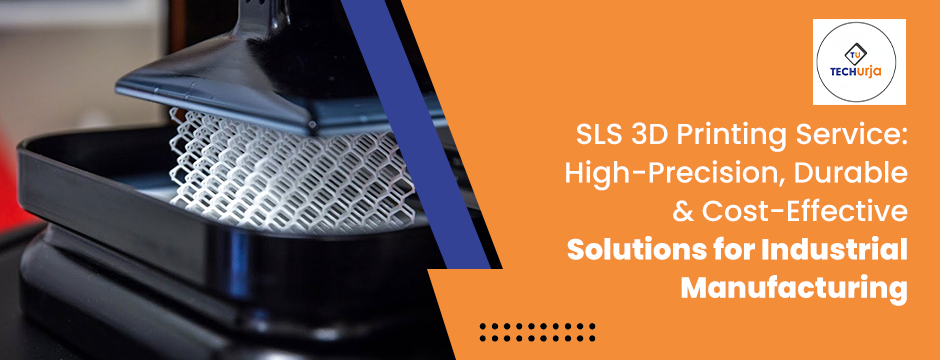
One exciting technology now available to manufacturers to meet these demands is Selective Laser Sintering (SLS). SLS 3D printing service is widely recognized for its ability to produce high-precision, durable, and production-grade components without the need for tooling or molds. It uses a high-energy laser beam to melt powdered material, fusing the material layer-by-layer, creating very complex geometries that are extremely difficult to create using traditional manufacturing techniques. The result of this process is a part that is functional, durable, and capable of being used immediately in production as a finished part.
SLS 3D Printing is being used in a variety of industries such as Aerospace, Automotive, Healthcare, Industrial Manufacturing, and Robotics to speed up an organisation’s innovation and to shorten their time-to-market. SLS is also utilising a low-cost, high-volume production model that can be used to produce prototype parts, functional prototypes, and/or end-use parts. In this blog, we explore how SLS 3D printing delivers unmatched precision, durability, and value for modern industrial manufacturing.
What Is SLS 3D Printing
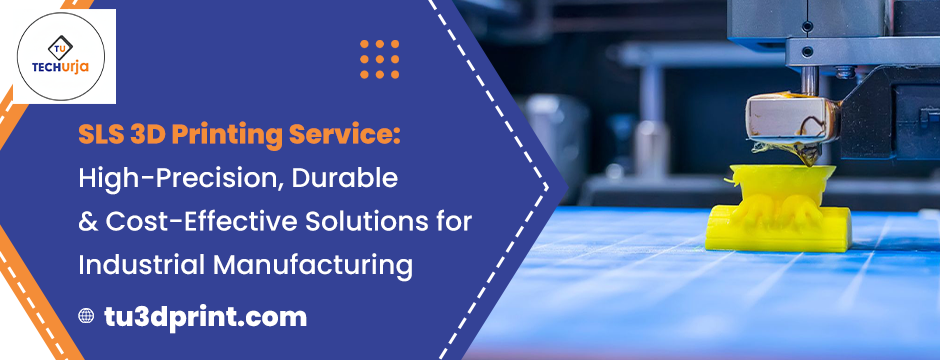
Selective Laser Sintering 3D printing is a method of 3D printing that can be seen as a form of additive manufacturing. While SLS is different from some other forms of 3D printing in that no support structures are required, it does use a laser to melt and fuse powdered materials to create a finished product. This means that SLS parts can be produced with very complex designs, as the surrounding powder will automatically provide stability to the printed part while it is being manufactured.
As a result of this ability, it is possible to create SLS components with highly intricate internal passages and many other attributes, such as lattices and interlocking assemblies, in one printing process. In addition to their strength and dimensional accuracy, SLS printed parts also have excellent thermal capabilities, allowing them to withstand extreme conditions while being utilized in real applications.
Why SLS 3D Printing Service Is Ideal for Industrial Manufacturing
High Precision and Design Freedom
SLS effectively produces high-accuracy dimensional parts with highly reliable reduced tolerances and fine detail. As a result, engineers can focus on design intent or performance rather than design constraints associated with manufacturing, resulting in innovative solutions without compromise.
Durable, Production-Ready Parts
SLS-manufactured components possess superior mechanical strength and isotropic properties, giving them high strength and reliability in all directions. This makes them the ideal choice for functional testing and for final production items.
Cost-Effective for Low to Medium Volumes
SLS is a cost-effective method of producing parts, as it doesn’t require any tooling to produce an object. Therefore, manufacturers are able to save significant amounts of money on up-front tooling costs when developing SLS parts.
Faster Time-to-Market
SLS 3D printing allows manufacturers to enhance their product development cycles, giving them the capability to go from concept to production much quicker than with conventional methods.
Material Versatility
The most common material types used for producing nylon SLS 3D printing parts are Nylon PA12 and PA11, glass-filled or carbon-filled nylon composite materials; these will provide flexibility of usage in many various industrial situations.
Applications of SLS 3D Printing Across Industries
SLS 3D printing services for prototypes are widely adopted across multiple sectors, including:
- Automotive: Functional prototypes, housings, ducts, and custom fixtures
- Aerospace: Lightweight components and complex internal structures
- Healthcare: Medical devices, enclosures, and custom tools
- Industrial Manufacturing: Jigs, fixtures, gears, and production parts
- Consumer Products: Durable end-use components and small-batch production
Its versatility makes SLS an indispensable technology for modern manufacturing needs.
Tu3dprint: Precision SLS 3D Printing Built for Industry
At Tu3dprint, we blend cutting-edge technology with expert craftsmanship to deliver high-quality industrial SLS 3D printing to address your needs. We don’t just manufacture parts; we help you innovate faster, smarter, and more affordably.
Our approach is built on transparency, efficiency, and precision. From instant quoting and manufacturability feedback to secure online payments and doorstep delivery, we make industrial manufacturing simple and stress-free. Our recent creations, including complex impellers, SLA and metal components, and industrial fan parts, reflect our commitment to quality and performance.
Whether you need rapid prototypes or production-ready components, we are your trusted partner for reliable, cost-effective SLS 3D printing services. Explore our solutions and get started today.
Final Thoughts
SLS 3D printing service has transformed the way industries design, prototype, and manufacture parts. The process delivers an effective manufacturing solution that provides superior precision and durability while maintaining cost efficiency compared to conventional production techniques. SLS technology enables businesses to achieve operational flexibility and cost savings while they develop new products to meet changing industrial requirements.
Manufacturers who work with Tu3dprint as their trusted service provider receive advanced technology and expert support through a completely smooth production process, which begins with design upload and ends with final delivery.
Before choosing an SLS 3D printing service, discover why SLA 3D printing is dominating precision-focused design teams.
Frequently Asked Questions (FAQs)
- What materials are commonly used in SLS 3D printing?
SLS typically uses nylon-based materials such as PA12, PA11, and reinforced composites for high strength and durability.
- Are SLS 3D printed parts suitable for end-use applications?
Yes, the SLS process produces high-quality components that are strong and heat-resistant and ideal for end-use functionality.
- How accurate is SLS 3D printing?
SLS offers a high-dimensional accuracy along with good surface consistency, which makes it an excellent option for producing highly complex industrial parts.
- Is SLS 3D printing cost-effective for small production runs?
Definitely! Because there is no need for tooling, SLS is very high-value for manufacturing low to medium-volume production runs.
- How long does it take to receive SLS 3D printed parts?
Depending on the complexity of the part and quantity ordered, expected lead times will vary. However, SLS generally offers a much faster turnaround time compared to traditional manufacturing methods.