
Additive manufacturing continues to evolve, but one technology still dominates functional prototyping and low-volume production. That technology is FDM printing. Businesses value it for speed, affordability, and flexibility. As 2026 approaches, demand continues to rise across engineering, manufacturing, healthcare, and product design.
This guide breaks down how an FDM 3D printing service works, what it costs, which materials perform best, and where it delivers the strongest value. Whether you build prototypes or production-ready components, understanding FDM helps you make smarter decisions.
What Is FDM 3D Printing and Why It Still Matters
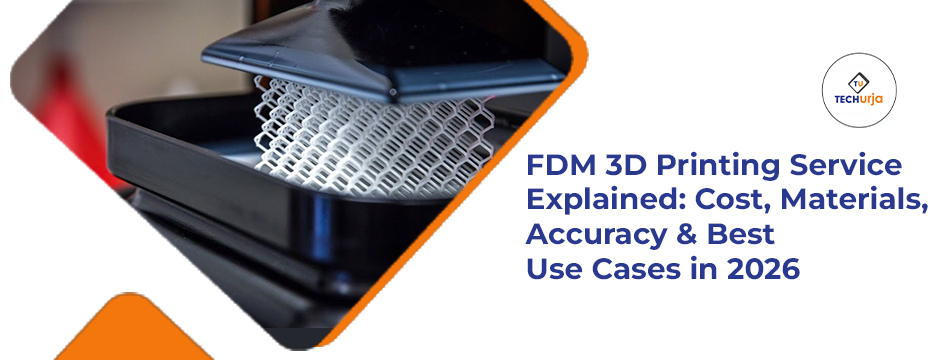
FDM stands for fused filament fabrication. It creates parts by melting thermoplastic filament and depositing it layer by layer. Each layer bonds to the previous one through heat and pressure.
This approach delivers strong mechanical properties while keeping costs controlled. Designers appreciate its simplicity. Engineers trust its reliability. Manufacturers value its scalability.
A modern FDM 3D printing service supports fast iteration without expensive tooling. That flexibility explains why FDM remains essential even as newer technologies emerge.
How the FDM Printing Process Works Step by Step
Every project begins with a digital model. Designers create or upload a CAD file. Software slices that file into layers. The printer then follows that path precisely.
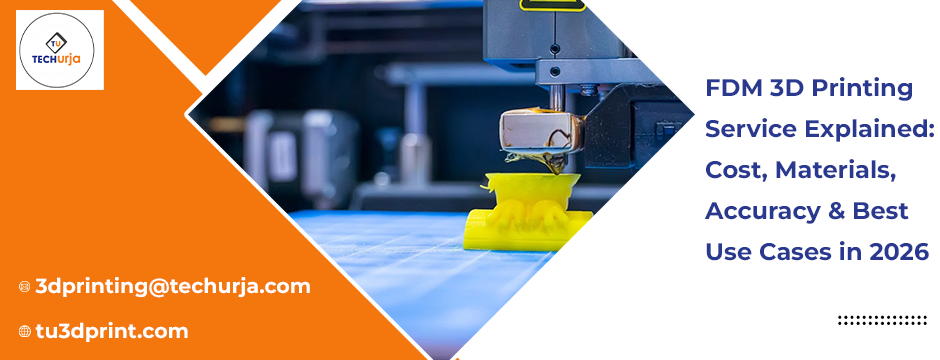
Heated nozzles extrude filament onto a build platform. Cooling fans solidify each layer quickly. The process repeats until the part reaches full height.
Print settings control strength, surface finish, and accuracy. Layer height, infill density, and print speed all influence final performance. Skilled providers fine-tune these variables for each application.
This controlled workflow makes FDM 3D printing service outputs predictable and repeatable.
Understanding Cost Factors in FDM Printing
Cost remains one of FDM’s strongest advantages. Several variables influence pricing, though.
Material choice plays a major role. Basic plastics cost less than high-performance filaments. Part size also affects price. Larger parts require more material and longer print times.
Design complexity matters too. Intricate geometries increase print duration and post-processing effort. However, FDM avoids mold costs entirely.
Compared to CNC or injection molding, FDM 3D printing service pricing stays accessible for early-stage development and small production runs.
Materials Used in FDM Printing and Their Performance
Material selection defines how a printed part behaves. FDM supports a wide range of thermoplastics.
PLA offers easy printing and smooth surfaces. ABS delivers higher temperature resistance. PETG balances strength and flexibility. Nylon adds durability and chemical resistance.
Advanced filaments include carbon fiber blends and heat-resistant polymers. These options support demanding applications without switching technologies.
Professional FDM 3D printing services help clients match materials to mechanical and environmental requirements.
Accuracy and Tolerances You Can Expect in 2026
Accuracy continues to improve as printers evolve. Modern machines achieve tight tolerances with proper calibration.
Layer resolution affects surface quality. Thinner layers produce smoother finishes. Dimensional accuracy depends on material shrinkage and print orientation.
FDM now supports functional tolerances suitable for testing assemblies and moving parts. While it cannot match high-end resin printing, it meets most engineering needs.
A reliable FDM 3D printing service delivers consistent accuracy through controlled environments and experienced operators.
Best Use Cases for FDM Printing Today
FDM shines where speed and function matter most. Engineers rely on it for concept validation and fit testing. Designers use it for form studies and user feedback.
Manufacturers apply it for jigs, fixtures, and tooling aids. Educational institutions depend on it for hands-on learning.
With durable materials, FDM also supports end-use components. Enclosures, brackets, and housings perform reliably in real-world conditions.
That versatility keeps FDM 3D printing service demand strong across industries.
FDM Printing in Rapid Prototyping Workflows
Rapid prototyping demands fast turnaround and low risk. FDM delivers both.
Design teams print multiple versions within days. Feedback cycles shorten. Product improvements accelerate. This agility reduces development costs significantly.
Through FDM rapid prototyping, teams test form, fit, and function before committing to mass production. That early validation prevents costly redesigns later.
Comparing FDM With Other 3D Printing Technologies
Each additive method serves different needs. Resin printing excels at detail. SLS handles complex geometries without supports. Metal printing supports extreme loads.
FDM balances affordability and functionality. It supports larger parts at a lower cost. Material options continue expanding.
A fused deposition modeling service often becomes the first choice for iterative development and functional testing.
Prototyping Versus Production With FDM
FDM once focused only on prototypes. That perception no longer fits reality.
Modern materials enable small-batch production. Print farms scale output efficiently. Consistent quality supports repeatable manufacturing.
Through FDM 3D printing for prototyping, teams transition smoothly into limited production runs. This continuity reduces supply chain friction.
Integrated 3D Solutions Beyond Printing
Printing alone does not solve every challenge. Successful projects combine multiple services.
Accurate 3D models drive better prints. Detailed drawings support manufacturing. Scanning bridges the physical and digital worlds.
End-to-end support ensures designs move efficiently from concept to reality. That integration saves time and reduces errors.
Why Expertise Matters in FDM Printing
Printer hardware alone does not guarantee results. Experience shapes outcomes.
Material behavior varies by environment. Geometry affects strength. Orientation influences accuracy. Skilled teams understand these nuances.
Professional providers optimize every stage. They anticipate challenges before printing begins.
That expertise defines the difference between basic prints and production-ready parts.
Commitment to End-to-End 3D Solutions
We focus on streamlining design and manufacturing workflows. We support projects from early concepts through final production.
Our services include additive manufacturing across multiple technologies. We create precise 3D models and technical drawings. We also provide advanced 3D scanning for reverse engineering.
We blend technology with craftsmanship to deliver efficient, affordable solutions. At TechUrja, we believe precision and accessibility should coexist. We, TechUrja, help you turn ideas into reliable, functional parts through our expertise and commitment.
Final Thought
As 3D manufacturing continues to advance, businesses still rely on solutions that balance speed, cost, and performance. A professional FDM 3D printing service offers that balance through reliable materials, scalable production, and rapid turnaround. It supports innovation without heavy upfront investment and adapts easily to changing design needs. From early concepts to functional parts, this technology empowers teams to test, refine, and build with confidence. When precision, efficiency, and flexibility matter, FDM printing remains a practical choice for modern product development and manufacturing workflows.
If your FDM 3D printing service project demands tougher materials, SLS 3D printing service may be the smarter move.
FAQ:-
- Is FDM printing suitable for functional parts?
Yes. Many materials provide strength and durability suitable for real-world applications.
- How fast can an FDM project be completed?
Most parts print within hours or days, depending on size and complexity.
- Can FDM printing handle complex geometries?
Yes. Supports enable complex shapes, though design optimization improves results.
- How durable are FDM printed parts?
Durability depends on material choice, print settings, and part orientation.
- When should I choose FDM over other technologies?
Choose FDM when you need affordable, fast, and functional prototypes or small production runs.