
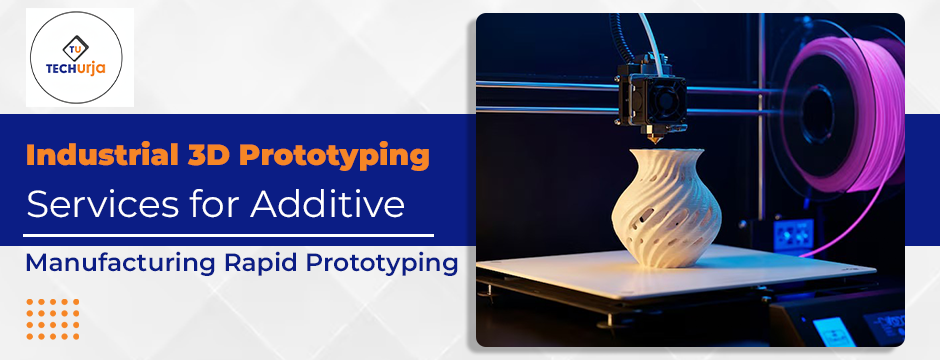
Industrial landscape moving at rapid speeds requires elements of accuracy, adaptability, and rapidness to stay ahead. Manufacturers, engineers, designers, and R&D are associated with an endless race to get from conceptualization to actual manufacturing at speeds. It is in this arena that industrial 3D prototyping services based on additive manufacturing rapid prototyping come as a game-changer.
In a non-additive manufacturing process, engineers and designers cannot generate functional prototypes from digital creations. However, with additive manufacturing, engineers and designers can recycle quickly when they need to check an object’s form and fit, check its function, or if they are preparing it for production. In any of these cases, an industrial 3D prototyping technique becomes a versatile tool.
Rapid prototyping is not merely a stage of testing; rather, it’s turned into a competitive benefit. Businesses are able to detect defects within designs, enhance performance, and speed up the launch of products to the market faster and more efficiently. In various fields, like aerospace and automobile to healthcare and consumer goods, industrial 3D prototyping assists in innovations at different development stages.
In this piece, we will discuss how 3D prototyping services aid in additive manufacturing, the importance of rapid prototyping, and how businesses can leverage these capabilities to accelerate product development.
What Is Industrial 3D Prototyping
Industrial 3D prototyping is based on the fabrication of prototypes using industrial-grade 3D printing technology. These prototypes have been fabricated using layers with materials that range from plastics, resins, nylons, to composites. It is characterized by high levels of accuracy.
In contrast to desktop 3D printing, functional 3D printed prototypes concentrate on functionality, precision, and practical application evaluation. This is not merely about visual representation but rather the development of parts that accurately resemble end-product parts.
The Role of Additive Manufacturing in Rapid Prototyping
Additive manufacturing eliminates the need for molds or tooling, hence it can provide rapid prototyping. As soon as one has a final digital CAD file, production can effectively be started on the spot.
Key benefits include:
- Faster design iteration
- Lower upfront costs
- Greater design freedom
- Time to market reduced
This makes additive manufacturing ideal for both early-stage concepts and late-stage functional testing.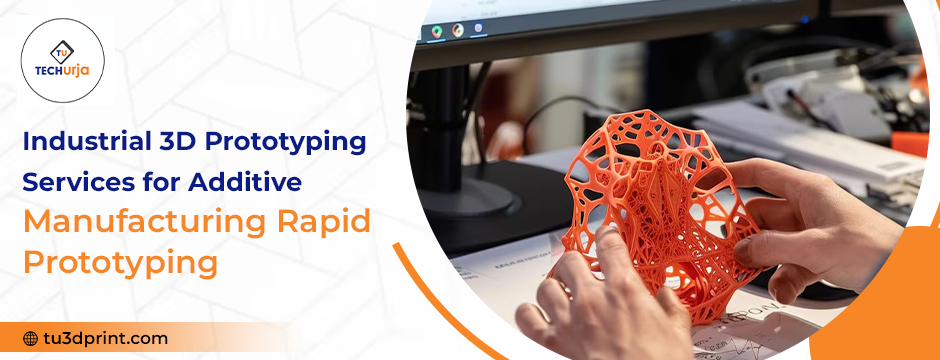
Benefits of Industrial 3D Prototyping Services
Faster Product Development Cycles
Rapid prototyping has the effect of drastically reducing development time. What would take several weeks to change in design and then test might now be done in a few days, thus enabling fast decision-making on innovations.
Improved Design Accuracy
Industrial 3D printing enables engineers to test form, fit, and function in advance, before full production. This greatly reduces the possibility of costly errors and redesigns later in the process.
Cost-Effective Prototyping
Companies can prototype multiple versions of a part at a fraction of the cost of traditional manufacturing methods by avoiding expensive tooling.
Complex Geometry Made Simple
Advanced additive manufacturing enables complex internal structures, lightweight designs, and geometries difficult or impossible to realize with conventional processes.
Functional Testing and Validation
These industrial prototypes can be further used for several other purposes, such as mechanical testing, thermal analysis, and real-world simulation, to validate if the design meets all the required performance criteria.
Applications Across Industries
Custom industrial prototyping is widely used across multiple sectors, including:
- Automotive: Functional parts, housings, and tooling prototypes
- Aerospace: Lightweight components and complex assemblies
- Medical: Device housings, surgical tools, and anatomical models
- Consumer Products: Ergonomic testing and aesthetic validation
- Industrial Equipment: Custom fixtures and replacement parts
The flexibility of additive manufacturing makes it suitable for both low-volume production and rapid iteration.
From Prototype to Production
One of the major beneficial uses of the industrial 3D prototyping process is that it can serve as the link between design and manufacturing. Prototypes can be manufactured from the same materials and using the same processes that would be used for final manufactured products.
This smooth transition enables manufacturers to easily transition from prototype acceptance to production readiness.
Why Precision and Consistency Matter
When working with industries, accuracy cannot be compromised. The prototype should be produced with precise tolerances, as it has to function properly even under actual working conditions.
Good industrial rapid prototyping systems emphasize repeatability, material integrity, and dimensioning. These parameters are very critical to a product development process.
How We Support Rapid Prototyping at Tu3dprint
This is where we, Tu3dprint’s rapid prototyping experts using 3D printing, come in. At Tu3dprint, we enable innovators, designers, and engineers to achieve their digital designs faster than they thought possible. The aim is to deliver consistently accurate and high-quality prototypes and final products that meet the required standards.
We work towards serving every aspect of product development, whether it is improving an existing design or striving towards designing the next big thing. All the services that we, at Rapid, offer in 3D printing and prototyping are developed with the intention of serving every aspect of your project, from validating an idea to functional testing and low-volume production, starting your project off on the right foot with our expertise in additive manufacturing.
End Thoughts
Industrial 3D prototyping services based on additive manufacturing technology have turned out to be an essential requirement in today’s world of product development. These services help in improving innovation with less emphasis on time.
For business enterprises requiring trustworthy and quality-assured rapid prototyping services, there is Tu3dprint, a professional service for rapid prototyping using 3D printing to ensure efficiency and accuracy in the working process.
If speed matters, industrial 3D prototyping services additive manufacturing rapid prototyping unlock the same rapid design strategies powering modern innovation.
Frequently Asked Questions (FAQs)
- How is rapid prototyping different from traditional prototyping?
Rapid prototyping applies additive manufacturing and allows the direct creation of prototypes from digital designs, whereas traditional prototyping may involve tools and take longer lead times.
- Are industrial 3D prototypes applicable to functional testing?
Yes, industrial prototypes using 3D printing are made from production materials and can be used for mechanical, thermal, and performance testing.
- How quickly can an additive-manufactured prototype be produced?
With respect to the part complexity and material, it can often be turned out in days rather than weeks.
- Can the service of industrial prototyping using 3D technology apply to low-volume production
Of course, additive manufacturing turns out to be very effective for low-series production, bridge production, and all that.
- In which sectors are rapid prototyping 3D printing technologies most valuable?
Industries that benefit from Rapid Prototyping services are Automotive, Aerospace, Medical, Consumer Products, and Industrial Manufacturing.